
by Norman Aceron Garcia
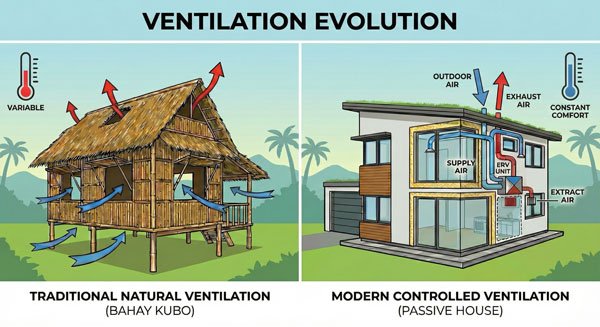
Long before the advent of electricity and air conditioning, our ancestors perfected the art of “living with the land.” The bahay kubo is not just a cultural icon; it is a masterclass in tropical design. Built on stilts with wide windows and high-pitched roofs, it utilized the stack effect-allowing hot air to rise and escape while drawing in cool breezes from below.
Fast forward to the 21st century, and we find ourselves trapped in concrete boxes that soak up the sun, forcing us to rely on expensive, energy-hungry air-conditioning units. But what if we could merge that ancestral wisdom with modern engineering? Enter the Passive House (Passivhaus) standard.
While the bahay kubo relies on being “open” to the elements, a Passive House in the tropics works on a “controlled” envelope. The goal remains the same: thermal comfort with minimal energy.
Shading: Just as the wide eaves (media aguas) of a traditional hut protect the interior from the midday sun, a Passive House uses strategic overhangs and high-performance glazing to block solar heat gain before it even enters the home.
Continuous insulation: In a bahay kubo, bamboo slats allow air to flow. In a Passive House, thick insulation and an airtight seal act like a high-end thermos, keeping the tropical heat out and the cool air in.
Mechanical ventilation: This is where the evolution peaks. Instead of relying solely on unpredictable winds, Passive Houses use heat recovery ventilation (HRV) or cooling systems that provide a constant stream of filtered, fresh air while dehumidifying it, addressing the one thing the bahay kubo couldn’t: Philippine humidity.
Working with nature
The philosophy hasn’t changed; the tools have simply levelled up. Transitioning to Passive House principles in tropical climates is a return to our roots. It’s about building homes that breathe, not by accident, but by design. By combining the “spirit” of the bahay kubo with the “science” of the Passive House, we can create a future that is sustainable, culturally resonant, and, above all, cool.
Norman Garcia is a certified Passive House Consultant with the AllClimate Consulting and founder of the Passivhaus Philippines.