
by Norman Aceron Garcia
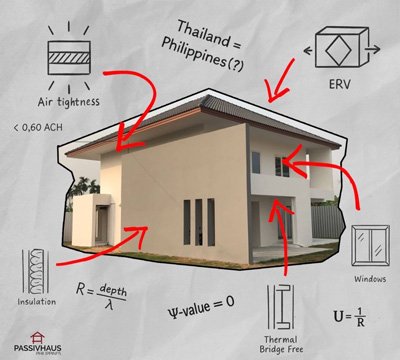 MANILA, October 2025 – What does it take to build a house that stays cool in sweltering tropical heat without guzzling electricity? That was the question explored at the second public webinar hosted by Passivhaus Philippines (PassivhausPH), which spotlighted lessons from Thailand’s very first certified Passive House.
The event drew architects, engineers, educators, suppliers, homebuilders and homeowners eager to see how the Philippines might adapt one of the world’s most ambitious building standards to its own hot and humid climate.
The featured speaker was Shih-Chieh (Jay) Yeh, lead architect at BWK Green Architecture of Taiwan, who helped design and deliver Thailand’s prototype Passive House in Bangkok. The project, a modest two-storey family home built in 2019, proved that world-class efficiency can be achieved even in the sticky heat of Southeast Asia.
“All of our design strategies are built around one simple idea: keeping heat out, and keeping the inside cool,” Yeh explained.
Unlike traditional designs, the Bangkok house uses thick layers of insulation not just on the roof, but also on the walls and even under the floor slab – important in a city where ground temperatures can reach 29 °C. High-performance double glazing keeps indoor glass surfaces from radiating heat, while careful shading and orientation help block the tropical sun. A compact ventilation unit with built-in cooling keeps fresh, dehumidified air flowing.
The result? The house consumes so little energy that its entire cooling demand can be met with a modest 3.5-kilowatt system – less than what many Filipino households already use for a couple of air-conditioning units.
The Philippine buildings are not built for the climate we live in. Families without air conditioning face impossible choices; do they spend on cooling, or put food on the table? The Passive House approach offers a way forward: first reduce heat loads through smart design; then right-size efficient cooling systems and finally add renewable energy.
Passivhaus Philippines advocates for ethical design and construction practices, ensuring sustainability efforts are pursued with integrity. Passivhaus Philippines envisions that by 2050, all Filipinos will live and work in healthy, low-energy, resilient buildings. Its mission is to make the Passive House Standard understood, achievable, and adopted across the country through education, advocacy, and technical support.
Support the mission by becoming a founding member or joining upcoming events.
Media & membership inquiries: Norman Garcia, Executive Director, Passivhaus Philippines