
by Norman Aceron Garcia
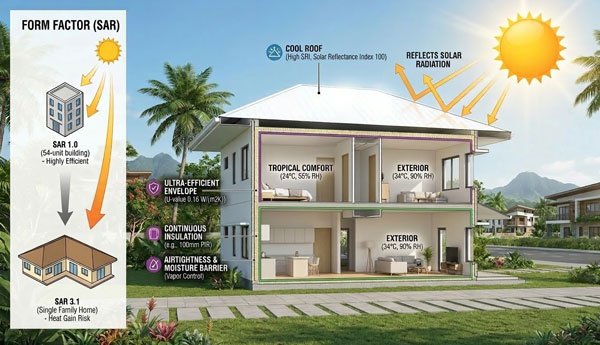
Designing for the heat in the Philippines is about more than just cranking up the air conditioning; it is about creating a barrier between your living space and the intense outdoor environment. This is the primary role of the building envelope, which acts as protection against the external environment including rain, sun, and air leakage.
A well-designed envelope must be carefully designed to manage temperature, airflow, and moisture to ensure a home is truly comfortable, healthy, durable, and efficient. By focusing on these fundamentals, architects and engineers can protect the internal environment from the harsh tropical sun while significantly reducing long-term energy costs.
A fundamental strategy in tropical building science is optimizing the “form factor,” also known as the Surface Area to Area Ratio (SAR). This metric is calculated by dividing the total building envelope area by the treated floor area (TFA). By designing more compact building forms, designers can significantly reduce the total surface area that is directly exposed to solar radiation. For example, while a typical single-family home might have a SAR of 3.1, a larger, more compact 54-unit building can achieve a SAR of 1.0, naturally lowering the internal heat load before any mechanical cooling is even turned on.
Because the roof is the most significant point of heat entry, “cool roofs” are a game changer for modern tropical design. Utilizing materials with a high Solar Reflectance Index (SRI) allows a structure to reflect solar radiation back into the atmosphere rather than absorbing it into the ceiling. A bright white material with an SRI of 100 is vastly superior to a standard black roof, which has an SRI of 0 and absorbs nearly all the solar energy it receives.
The final defences for a high-performance envelope are continuous insulation and managed airtightness. Regional successes, such as Thailand’s first certified Passive House, achieved an impressive assembly U-value of 0.16 W/(m2K) by utilizing a solid construction envelope with 100 mm of high-performance polyisocyanurate (PIR) insulation. Similarly, the Austrian Embassy in Jakarta utilized 130 mm of thermal insulation to achieve a U-value of 0.32 W/(m2K).
In hot-humid climates, the airtightness layer also acts as the primary barrier to prevent outdoor moisture from infiltrating and condensing on cooled interior surfaces. This prevents mould growth and “sweating” at supply grilles, ensuring the health and durability of the structure. Because dehumidification is often a separate and more energy-intensive process than sensible cooling in the tropics, a science-based building envelope is essential for achieving true energy efficiency and thermal comfort.